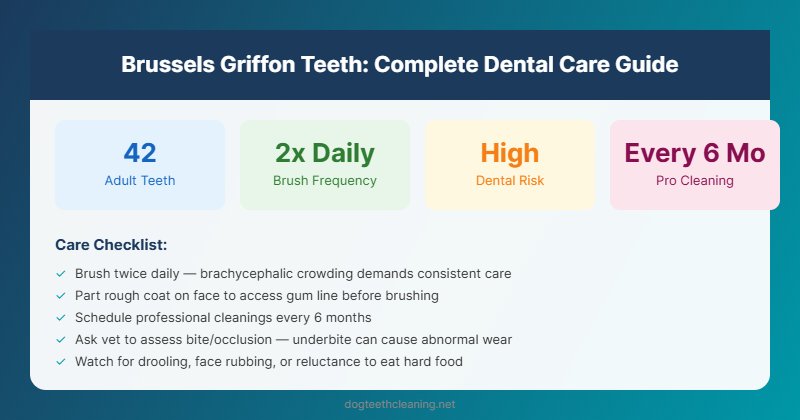
brussels griffon teeth is a lifelong commitment that every Brussels Griffon owner should prioritize. Brussels Griffons have the same 42 adult teeth as other dogs, yet their unique jaw structure, size, and temperament create specific dental challenges worth understanding. This complete guide covers everything you need to know about brussels griffon teeth care, brushing techniques, professional cleanings, and warning signs.
Brussels Griffon Teeth: Anatomy and Dental Profile
The Brussels Griffon is a brachycephalic toy breed with one of the most distinctive, almost human-like faces in dogdom. That characteristic flat face, prominent chin, and large expressive eyes are products of a severely compressed skull — and that compression creates the same dental crowding seen in all flat-faced breeds. All 42 permanent teeth must fit into a jaw far shorter than ancestral dogs had, producing overlapping incisors, rotated premolars, and angled molars. The Griffon comes in two coat varieties — rough (wiry) and smooth — and the rough coat around the face can trap food particles near the mouth, adding an additional risk factor. The prominent lower jaw (underbite) is a breed standard feature but can complicate how teeth meet and how cleaning tools access surfaces.
According to the American Veterinary Medical Association (AVMA), dental disease is the most common health condition in adult dogs, affecting over 80% of dogs by age three. For Brussels Griffons, early and consistent brussels griffon teeth care is the most effective prevention strategy.
How to Brush Brussels Griffon Teeth
Brush your Brussels Griffon’s teeth twice daily. For rough-coated Griffons, gently part the wiry facial fur to access the lips and teeth — a small, soft-bristled brush angled at 45 degrees to the gum line works well. For smooth-coated dogs, access is more straightforward. Use enzymatic dog toothpaste that is safe to swallow, as Griffons rarely rinse and spit. Work methodically front to back on both upper and lower arcades, paying extra attention to the back premolars and molars where tartar accumulates fastest. Because of the brachycephalic jaw, some teeth will be difficult to reach — enzymatic toothpaste provides chemical antimicrobial benefit even in areas bristles cannot physically access.
- Choose the right tools: Use a dog-specific toothbrush or silicone finger brush with enzymatic toothpaste formulated for dogs.
- Start slow: Let your Brussels Griffon sniff and lick the toothpaste before introducing the brush.
- Focus on the gumline: Hold the brush at a 45-degree angle to the gum line where plaque accumulates.
- Brush in circles: Use small circular motions on all tooth surfaces — outer, inner, and chewing surfaces.
- Reward generously: Always follow brushing with praise or a dental treat to build positive associations.
Warning Signs of Dental Problems in Brussels Griffons
Brussels Griffons are at high risk for periodontal disease due to jaw compression and dental crowding. Their characteristic underbite places unusual stress on the points where upper and lower teeth meet, which can lead to abnormal wear patterns over time. Signs of dental disease include foul breath, drooling, reluctance to chew, face rubbing, or food dropping. Gum recession and tooth root exposure can occur without obvious outward symptoms. Given their brachycephalic airway, dental pain may manifest as snoring, snorting, or increased respiratory effort as dogs tense up around a painful mouth. Never ignore persistent bad breath in this breed — it is almost always a sign of active dental disease that requires professional intervention.
- Persistent bad breath (halitosis) beyond normal “dog breath”
- Visible yellow-brown tartar deposits on teeth, especially near the gum line
- Red, swollen, or bleeding gums
- Loose or missing teeth
- Difficulty chewing, dropping food, or avoiding hard kibble
- Pawing at the mouth or face
- Drooling more than usual
- Facial swelling, especially below the eye (possible tooth abscess)
Professional Dental Cleaning for Brussels Griffons
Schedule professional dental cleanings every 6 months for your Brussels Griffon. Because brachycephalic breeds require specific anesthetic protocols, choose a veterinarian familiar with flat-faced dogs. Pre-anesthetic screening including bloodwork and a thorough airway assessment is essential. Professional dental cleanings include ultrasonic scaling above and below the gum line, polishing, full-mouth radiographs, and periodontal probing. Given the degree of crowding typical in this breed, some teeth may require extraction if root or bone disease is detected — early professional intervention minimizes the number of extractions needed over the dog’s lifetime.
Professional cleanings involve a thorough examination, full-mouth dental X-rays, scaling above and below the gumline, polishing, and treatment of any diseased teeth. Your vet will also assess for periodontal disease, a common but serious condition if left untreated. Most dogs recover fully within 24 hours and immediately benefit from a clean, healthy mouth.
Diet and Dental Chews for Brussels Griffon Teeth
A complete, size-appropriate diet is important for the Brussels Griffon’s overall health and dental wellness. Toy-breed-formulated kibble is sized and shaped for small mouths and provides mild mechanical cleaning during chewing. Avoid a purely wet-food diet as it leaves more residue on tooth surfaces. VOHC-approved dental chews made for small breeds can provide daily supplemental plaque control. Water additives with plaque-inhibiting ingredients bearing the VOHC Accepted seal can be added to the water bowl for an effortless daily benefit. Avoid high-sugar treats or table scraps, as sugars feed the oral bacteria responsible for plaque and tartar formation.
- VOHC-approved dental chews: Look for the Veterinary Oral Health Council (VOHC) seal on dental treats.
- Dry kibble: Crunchy kibble creates a mild abrasive effect that reduces plaque — better than soft food alone.
- Raw carrots or apple slices: Natural crunchy snacks that help clean teeth mechanically.
- Dental water additives: Antimicrobial additives in drinking water reduce bacteria in the mouth.
- Avoid: Sticky treats, cooked bones, and hard items that can crack teeth (e.g., antlers, ice).
Brussels Griffon-Specific Dental Notes
The Brussels Griffon is a small dog with a large, complex personality — curious, affectionate, and sometimes stubborn. That stubbornness can make dental care challenging unless the routine is established early in puppyhood. Begin mouth handling from the day you bring your puppy home, working gradually over two to three weeks from lip touches to full brushing. Their almost human expressions make it easy to read their mood — watch for stiffening, head-turning, or pawing as cues to slow down and use more positive reinforcement. Both coat varieties require the same dental regimen; however, rough-coated Griffons additionally benefit from keeping the muzzle fur trimmed short to reduce food trapping near the mouth and simplify daily brushing.
Learn more about the AKC’s Brussels Griffon breed profile to understand this breed’s full health needs. For a complete overview of dental care across all life stages, visit our breed dental health guide and our comprehensive dog dental care resource.
Frequently Asked Questions About Brussels Griffon Teeth
- Q: Do all Brussels Griffons have teeth problems?
Not all, but the breed is genetically predisposed to dental crowding because of its brachycephalic skull structure. The majority of Brussels Griffons will develop some degree of periodontal disease without consistent home care and regular professional cleanings. With twice-daily brushing and bi-annual veterinary cleanings, dental disease is largely preventable. - Q: Is the Brussels Griffon underbite dangerous for their teeth?
A mild underbite is normal and part of the breed standard; most Griffons adapt well. However, a severe malocclusion where lower teeth contact the upper palate can cause trauma, pain, and accelerated wear. If your dog’s bite looks unusual or they seem uncomfortable eating, ask your veterinarian for a dental occlusion assessment. - Q: How do I brush a Brussels Griffon’s teeth with all that facial hair?
Use one hand to gently pull back the lip while the other holds the brush. Part the wiry beard and moustache with your fingers to expose the gum line, then work in small circular motions. For particularly hairy areas, a finger brush can be easier to maneuver than a traditional toothbrush. Keeping the muzzle fur trimmed also simplifies daily brushing significantly. - Q: What age do Brussels Griffons get their permanent teeth?
Brussels Griffon puppies start losing their baby teeth around 3–4 months of age, and all permanent teeth are usually in place by 6–7 months. During this transition, inspect the mouth regularly for retained deciduous teeth — a common issue in brachycephalic toy breeds that requires veterinary attention if present.