Not every dog faces the same dental risk. A Yorkshire Terrier and a Labrador can get the exact same home care and end up with very different mouths — because size and skull shape, more than anything an owner does, set the baseline for how likely a dog is to develop periodontal disease. This guide explains why, and gives you a size- and breed-based plan for what your dog actually needs.
Across more than three million dogs in one large U.S. veterinary dataset, about 18% had periodontal disease on record — and that figure understates true prevalence, because early disease often goes undiagnosed. The pattern underneath that number is what matters: the smaller the dog, the higher the risk.
Why size drives dental risk
In the largest study of its kind, researchers at the Waltham Petcare Science Institute found that extra-small dogs (under ~6.5 kg) were up to five times more likely to be diagnosed with periodontal disease than dogs weighing 25 kg or more. Small breeds overall were roughly two to three times more likely to be affected than large breeds.
The mechanism is simple geometry. Selective breeding shrank dogs’ jaws far faster than it shrank their teeth. A toy breed still carries 42 adult teeth — the same count as a Labrador — crammed into a fraction of the jaw length. Crowded teeth trap plaque, hair and food, and crowding makes natural cleaning (and home brushing) far less effective. Add commonly retained baby teeth in small breeds, which create extra plaque traps, and disease starts early and moves fast.
Why flat-faced (brachycephalic) breeds are a special case
Brachycephalic breeds — Pugs, French Bulldogs, Bulldogs, Boston Terriers, Shih Tzus — carry the small-jaw problem to an extreme. The shortened upper jaw forces teeth to rotate and overlap, sometimes almost stacking on top of one another. Veterinary dentistry references describe rotation and crowding as hallmark findings in these breeds, and severely rotated teeth are often extracted because they cannot be kept clean. Many flat-faced dogs also have a Class III bite (underbite), which adds soft-tissue trauma to the mix.
Small and brachycephalic breeds (Shih Tzu, Lhasa Apso, Pug) sit at the very top of the risk scale — they get both problems at once.
The large-breed exception
Size isn’t the whole story. In the Waltham data the single highest-prevalence breed was actually the Greyhound (38.7%) — a large, long-muzzled sighthound. Sighthounds appear genuinely predisposed to periodontal disease despite their size, and they also tend to be sensitive to anesthesia, which complicates treatment. Meanwhile, big chewing breeds like Labradors and German Shepherds face a different threat: fractured teeth from hard chews, bones and antlers, rather than crowding-driven gum disease. Their risk is real, just a different shape.
Dental risk by breed: the comparison table
Use the table to find where your dog sits and what that means for home care and professional cleanings. Cleaning cadence reflects the AAHA Dental Care Guidelines. Click a breed to open its detailed dental guide.
| Risk tier | Representative breeds | Size / skull type | Primary dental threat | What it needs |
|---|---|---|---|---|
| Highest — toy & small | Chihuahua, Yorkshire Terrier, Toy Poodle, Papillon, Pomeranian, Maltese, Dachshund | Toy / small, normal-to-long muzzle | Crowding in a tiny jaw, retained baby teeth, early-onset periodontal disease | Daily brushing from puppyhood; vet exam + cleaning under anesthesia yearly from age 1 |
| Highest — small & flat-faced | Shih Tzu, Pug, French Bulldog, Boston Terrier | Small, brachycephalic | Tooth rotation & overlap, underbite, plaque traps; anesthesia needs extra planning | Daily brushing; yearly cleanings; discuss airway-aware anesthesia with your vet |
| Elevated — small-medium | Cavalier King Charles Spaniel, Bichon Frise, Havanese, West Highland Terrier, Miniature Poodle | Small-medium | Periodontal disease, breed-specific links (e.g. heart disease in Cavaliers) | Daily brushing; yearly cleanings from age 1 |
| Moderate — medium | Cocker Spaniel, Beagle, Border Collie, Australian Shepherd, Corgi | Medium, normal muzzle | Standard periodontal risk; some lip-fold or chew-wear issues | Brush several times weekly (daily is better); professional cleaning every 1–2 years |
| Different threat — large & giant | Labrador Retriever, Golden Retriever, German Shepherd, Rottweiler, Great Dane | Large / giant | Fractured teeth from hard chews/bones more than crowding | Avoid bones, antlers & hard nylon chews; brush regularly; vet exam + cleaning from age 2 |
| Outlier — sighthounds | Greyhound, Whippet | Large, long muzzle | High periodontal disease despite size; anesthesia sensitivity | Daily brushing; don’t postpone cleanings; use a vet experienced with sighthound anesthesia |
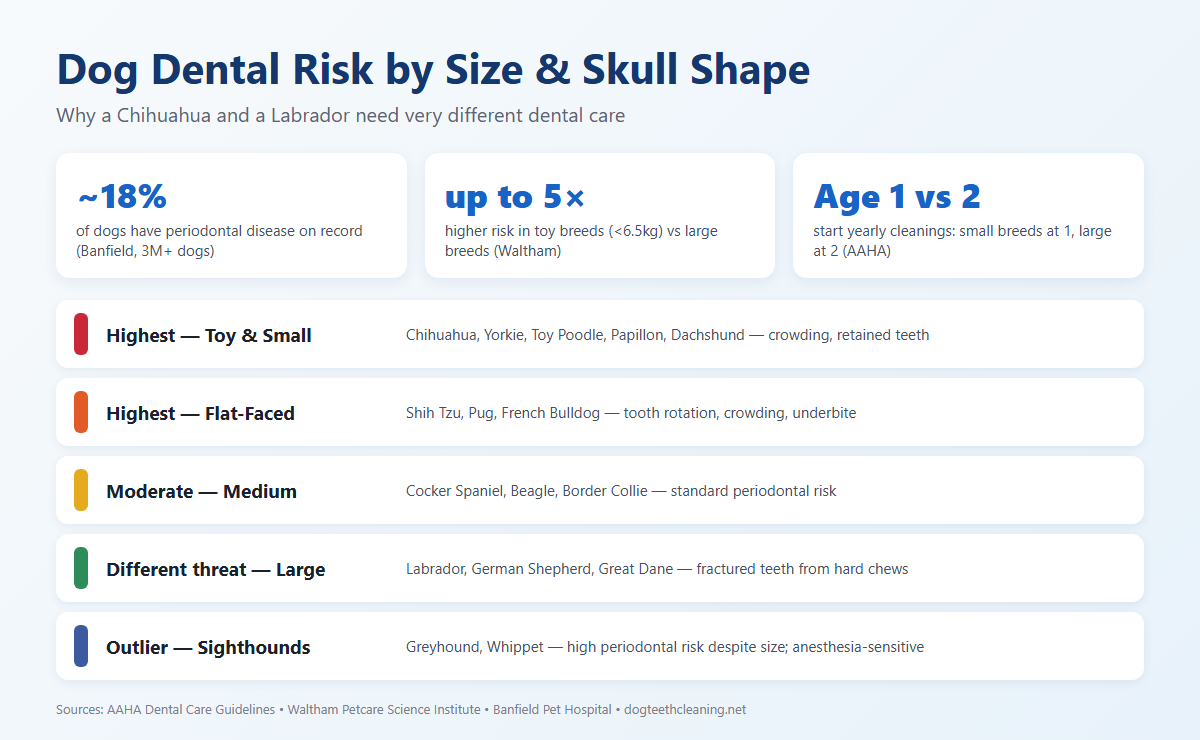
This table is a starting point, not a diagnosis. Individual dogs vary, and your veterinarian’s exam is the only way to know your dog’s actual oral health.
Home care that actually reduces disease
Two things move the needle at home:
Brushing. Daily brushing with a dog-specific toothpaste is the single most effective home measure. Never use human toothpaste — see why human toothpaste is unsafe for dogs — and if your dog won’t tolerate a brush yet, start with our guide to brushing a dog’s teeth the right way.
Proven products. When choosing chews, water additives or toothpastes, look for the Veterinary Oral Health Council (VOHC) Seal of Acceptance. The VOHC awards its seal only to products that demonstrate a meaningful reduction in plaque or tartar across testing — a minimum 15% reduction per trial and at least 20% on average across two trials. The seal is the most reliable shortcut past marketing claims. Our VOHC-approved dental chew picks and best dog toothpaste guide start there.
When your dog needs a professional cleaning
Home care slows disease; it does not remove tartar below the gumline, where damage actually happens. That requires a professional cleaning under general anesthesia, which allows a full exam, scaling below the gumline, polishing, dental X-rays and any needed extractions. The AAHA recommends these cleanings yearly from age 1 for small-breed dogs and from age 2 for larger breeds, adjusted to what your vet finds.
One caution worth repeating: the AAHA considers anesthesia-free “dentistry” unacceptable. It only scrapes visible tartar above the gumline, leaving the disease process untouched while making teeth look cleaner — a cosmetic result that can mask a worsening problem.
Frequently asked questions
Which dog breeds have the worst teeth?
Toy and small breeds with crowded jaws — Chihuahuas, Yorkshire Terriers, Toy Poodles, Papillons — and small flat-faced breeds like the Shih Tzu top most lists. In large veterinary datasets the Greyhound also shows unusually high periodontal disease despite its size.
Do small dogs really need more dental care than big dogs?
Yes. Veterinary research shows the smallest dogs are several times more likely to develop periodontal disease, and guidelines recommend starting annual cleanings a year earlier for small breeds (age 1) than for large breeds (age 2).
Does my dog’s breed change how I should brush?
The technique is the same, but crowded small and flat-faced breeds benefit most from daily brushing and earlier professional care, because plaque builds in spaces a brush can’t fully reach. Large breeds need the same brushing plus protection from tooth fractures.
This guide is educational and based on the sources listed below. It is not a substitute for veterinary advice — consult your veterinarian for guidance specific to your dog.
Sources
- American Animal Hospital Association — Your Pet’s Dental Care and 2019 AAHA Dental Care Guidelines for Dogs and Cats.
- Wallis C. et al., Waltham Petcare Science Institute — periodontal disease prevalence by body size (reported in The Veterinary Journal).
- Banfield Pet Hospital — periodontal disease prevalence across >3 million dogs.
- Niemiec B. et al. — Breed Predispositions to Dental and Oral Disease in Dogs (Wiley), on brachycephalic crowding and rotation.
- Merck Veterinary Manual — Dental Disorders of Dogs.
- Veterinary Oral Health Council — About the VOHC and Seal of Acceptance protocols.