japanese chin teeth is a lifelong commitment that every Japanese Chin owner should prioritize. Japanese Chins have the same 42 adult teeth as other dogs, yet their unique jaw structure, size, and temperament create specific dental challenges worth understanding. This complete guide covers everything you need to know about japanese chin teeth care, brushing techniques, professional cleanings, and warning signs.
Japanese Chin Teeth: Anatomy and Dental Profile
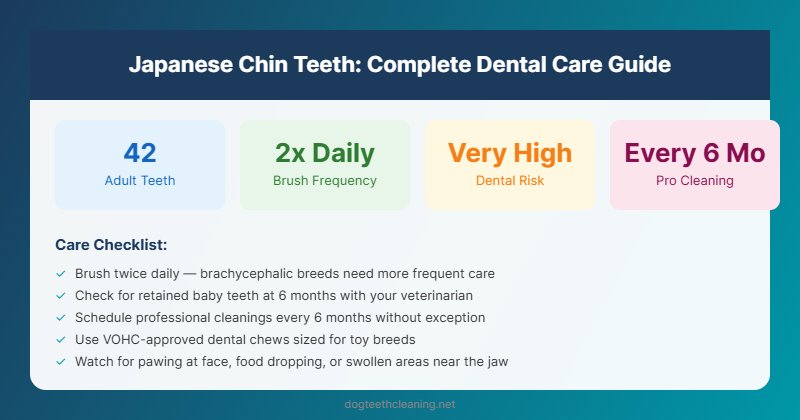
The Japanese Chin is a brachycephalic breed — its skull is compressed and broad relative to its length — which creates significant dental crowding. All 42 adult teeth must fit into a jaw substantially shorter than the tooth count was designed for, resulting in teeth that overlap, rotate, and erupt at abnormal angles. This crowding traps food debris and creates bacterial pockets between teeth that are nearly impossible to clean without professional tools. The Chin’s prominent eyes and flat face are signature traits, but the underlying skull compression is the primary driver of their elevated dental disease risk. Retained deciduous (baby) teeth are also common in this breed and should be evaluated by a veterinarian if present beyond 6 months of age.
According to the American Veterinary Medical Association (AVMA), dental disease is the most common health condition in adult dogs, affecting over 80% of dogs by age three. For Japanese Chins, early and consistent japanese chin teeth care is the most effective prevention strategy.
How to Brush Japanese Chin Teeth
Brushing a Japanese Chin’s teeth requires extra patience due to their flat face and small mouth. Use the smallest soft-bristled brush or a finger brush that fits comfortably, and angle it carefully to reach teeth that may be rotated or overlapping. Brush twice daily, working gently around the gum line at a 45-degree angle. The wrinkle folds around their face should also be wiped daily with a damp cloth, as debris accumulating in skin folds can migrate toward the mouth. Use only enzymatic toothpaste formulated for dogs — enzymatic action provides chemical antibacterial benefit even in areas the bristles struggle to physically reach, which is especially important given the degree of crowding typical in this breed.
- Choose the right tools: Use a dog-specific toothbrush or silicone finger brush with enzymatic toothpaste formulated for dogs.
- Start slow: Let your Japanese Chin sniff and lick the toothpaste before introducing the brush.
- Focus on the gumline: Hold the brush at a 45-degree angle to the gum line where plaque accumulates.
- Brush in circles: Use small circular motions on all tooth surfaces — outer, inner, and chewing surfaces.
- Reward generously: Always follow brushing with praise or a dental treat to build positive associations.
Warning Signs of Dental Problems in Japanese Chins
Japanese Chins are at very high risk of periodontal disease, often developing significant dental issues by age 2–3 without preventive care. Their brachycephalic jaw structure makes natural chewing less efficient, so mechanical self-cleaning from eating is reduced compared to longer-snouted breeds. Signs of dental disease include persistent bad breath, pawing at the face, dropping food while eating, facial swelling, or blood-tinged saliva. Retained baby teeth are common — if puppy teeth have not fallen out by 6 months, a veterinary dental evaluation is critical, as retained teeth cause severe crowding and accelerate disease. Because Japanese Chins are stoic, dental pain may not be obvious until disease is advanced.
- Persistent bad breath (halitosis) beyond normal “dog breath”
- Visible yellow-brown tartar deposits on teeth, especially near the gum line
- Red, swollen, or bleeding gums
- Loose or missing teeth
- Difficulty chewing, dropping food, or avoiding hard kibble
- Pawing at the mouth or face
- Drooling more than usual
- Facial swelling, especially below the eye (possible tooth abscess)
Professional Dental Cleaning for Japanese Chins
Japanese Chins should receive professional dental cleanings every 6 months — twice yearly is the standard for brachycephalic toy breeds. Because their teeth are crowded and angled in ways that make home brushing inadequate as a sole intervention, professional scaling and charting are essential. Dental radiographs are especially important for this breed to detect root resorption and bone loss invisible to the naked eye. Discuss with your veterinarian whether a pre-anesthetic blood panel and careful anesthetic monitoring protocols are in place, as brachycephalic breeds have elevated anesthesia risk requiring specific preparation including pre-oxygenation and careful intubation.
Professional cleanings involve a thorough examination, full-mouth dental X-rays, scaling above and below the gumline, polishing, and treatment of any diseased teeth. Your vet will also assess for periodontal disease, a common but serious condition if left untreated. Most dogs recover fully within 24 hours and immediately benefit from a clean, healthy mouth.
Diet and Dental Chews for Japanese Chin Teeth
Feed your Japanese Chin a size-appropriate complete diet, ideally kibble designed for toy or small breeds. Their flat faces can make eating large kibble difficult, so appropriately sized pieces support better chewing mechanics. Avoid wet food as the sole diet, as it contributes to faster plaque buildup without the mild abrasion of dry kibble. VOHC-approved dental chews and water additives can supplement brushing. Dental-formulated diets such as Hill’s Prescription Diet t/d have clinical evidence of plaque and tartar reduction and may be worth discussing with your veterinarian for high-risk brachycephalic breeds.
- VOHC-approved dental chews: Look for the Veterinary Oral Health Council (VOHC) seal on dental treats.
- Dry kibble: Crunchy kibble creates a mild abrasive effect that reduces plaque — better than soft food alone.
- Raw carrots or apple slices: Natural crunchy snacks that help clean teeth mechanically.
- Dental water additives: Antimicrobial additives in drinking water reduce bacteria in the mouth.
- Avoid: Sticky treats, cooked bones, and hard items that can crack teeth (e.g., antlers, ice).
Japanese Chin-Specific Dental Notes
The Japanese Chin is an ancient companion breed prized for its gentle, cat-like temperament and quiet demeanor. This calm nature can actually work in your favor during dental care — the breed tends to be cooperative with gentle handling when conditioned from puppyhood. However, their flat face and deep wrinkle folds mean dental care must be paired with routine facial hygiene. Never assume quietness means pain-free; Chins are stoic and may hide dental discomfort until disease is advanced. Regular veterinary dental examinations every 6 months — not just when you suspect a problem — are the most important single step any Japanese Chin owner can take for their companion’s wellbeing.
Learn more about the AKC’s Japanese Chin breed profile to understand this breed’s full health needs. For a complete overview of dental care across all life stages, visit our breed dental health guide and our comprehensive dog dental care resource.
Frequently Asked Questions About Japanese Chin Teeth
- Q: Why are Japanese Chins more prone to dental disease?
Their brachycephalic skull compresses the jaw while the number of teeth remains the same as longer-snouted breeds. The result is severe crowding, tooth rotation, and food-trapping spaces that accelerate plaque and tartar buildup significantly faster than in breeds with a normal jaw length. - Q: How often should I take my Japanese Chin for professional dental cleanings?
Every 6 months is the standard recommendation for brachycephalic toy breeds like the Japanese Chin. Some individuals may need cleanings every 4–5 months based on how quickly their tartar accumulates — your veterinarian can advise based on your specific dog’s history. - Q: What if my Japanese Chin refuses to let me brush their teeth?
Start with fingertip handling of the gums daily, then progress to a finger brush with tasty toothpaste before introducing a brush. If the dog resists despite gradual conditioning, discuss veterinary-grade dental diets and VOHC-approved water additives with your vet as supplementary tools. Daily brushing, even imperfect, is always better than none. - Q: Are retained baby teeth dangerous for Japanese Chins?
Yes. Retained deciduous teeth create double rows that crowd permanent teeth into abnormal positions and trap food between adjacent surfaces. This significantly accelerates periodontal disease. Any retained tooth should be evaluated and, if appropriate, extracted by a veterinarian — ideally at the time of spay or neuter surgery.