Caring for your Mountain Cur‘s teeth is one of the most important things you can do for their long-term health. Dental disease affects over 80% of dogs by age three, and mountain cur teeth care requires a breed-specific approach.
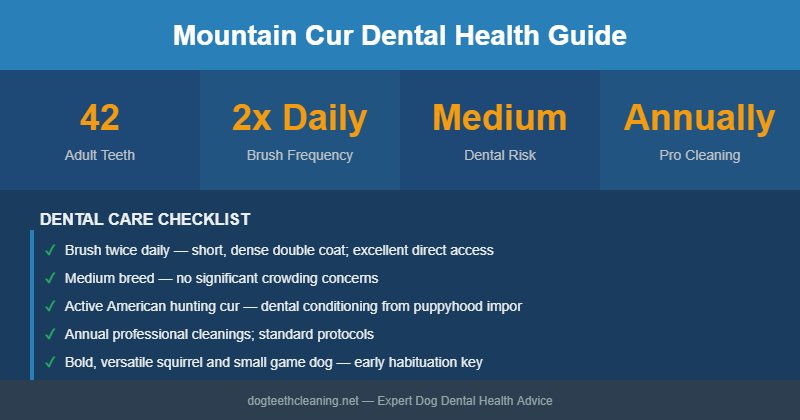
Mountain Cur Dental Anatomy & Risk Profile
The Mountain Cur is a sturdy American cur-type working breed, weighing 30 to 60 pounds, developed by early settlers in the Southern Appalachian Mountains and Ozarks as a versatile hunter and homestead guardian. The breed has a moderate-length muzzle providing good jaw space for all 42 permanent adult teeth with no significant crowding. The short, dense double coat in brindle, yellow, brown, or black lies flat against the face with excellent gum line access. Dental disease risk is moderate — consistent with medium American working cur breeds.
How to Brush Your Mountain Cur’s Teeth
Brush your Mountain Cur’s teeth twice daily using a medium toothbrush or finger brush with enzymatic dog toothpaste. The short coat provides excellent direct gum line access. Work at a 45-degree angle. Mountain Curs are bold, loyal, and intensely driven — dental conditioning from early puppyhood is important before this breed’s hunting drive fully matures.
Warning Signs of Dental Disease in Mountain Curs
Moderate dental disease risk consistent with medium American working cur breeds. Signs include bad breath, tartar buildup, gum redness or bleeding.
Professional Dental Cleanings for Mountain Curs
Annual professional dental cleanings with standard anesthetic protocols.
Diet and Dental Health for Mountain Curs
High-quality complete diet for a medium active hunting breed. Dry kibble, VOHC-approved dental chews, water additives.
Breed Notes: Mountain Cur
The Mountain Cur was one of the essential dogs of early American Appalachian and Ozark settlement, used for hunting squirrel, bear, and wild hog, and for guarding homesteads. Recognized by the United Kennel Club and AKC Foundation Stock Service. Lifespan 12–16 years.
For authoritative veterinary dental guidelines, see the AVMA pet dental care guide and the AKC Mountain Cur breed page.
Frequently Asked Questions: Mountain Cur Teeth
What is the difference between a Mountain Cur and a Mountain Feist?
The Mountain Cur and Mountain Feist are similar Appalachian working breeds but differ in size and purpose. The Mountain Cur is larger (30–60 lbs) and more versatile, hunting both tree game and larger quarry. The Mountain Feist is smaller (12–30 lbs) and specialized primarily for squirrel hunting.
How often should Mountain Curs have professional dental cleanings?
Annual cleanings for dogs with excellent home care. Standard anesthetic protocols are appropriate for this medium-sized American breed.
Is the Mountain Cur AKC recognized?
The Mountain Cur is recognized through the AKC Foundation Stock Service (FSS) and has full United Kennel Club (UKC) recognition.
Is the Mountain Cur a purebred dog?
Yes — the Mountain Cur has been recognized as a distinct breed since the 1950s, with the Original Mountain Cur Breeders Association (OMCBA) founded in 1956 to preserve and standardize the breed.