pekingese teeth is a lifelong commitment that every Pekingese owner should prioritize. Pekingeses have the same 42 adult teeth as other dogs, yet their unique jaw structure, size, and temperament create specific dental challenges worth understanding. This complete guide covers everything you need to know about pekingese teeth care, brushing techniques, professional cleanings, and warning signs.
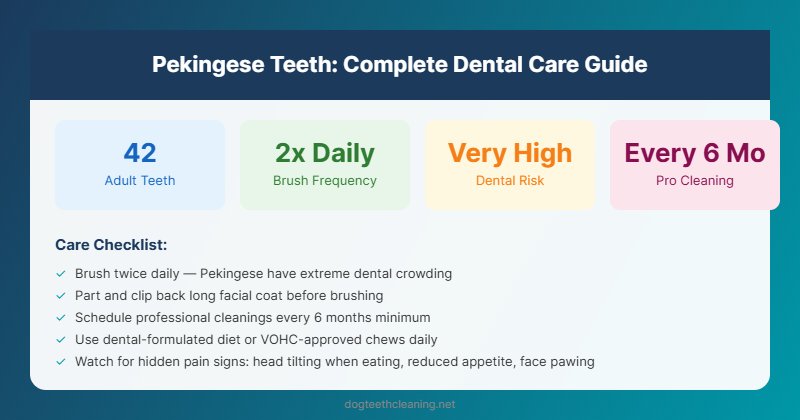
Pekingese Teeth: Anatomy and Dental Profile
The Pekingese is one of the most extreme brachycephalic breeds in existence — its flat, broad skull and extremely compressed muzzle are defining characteristics developed through centuries of selective breeding in imperial China. This skull structure creates severe dental crowding: all 42 permanent teeth are packed into a jaw with very little longitudinal space, leading to widespread tooth rotation, overlapping incisors, malaligned premolars, and teeth erupting at acute angles. The Pekingese’s long, flowing facial coat — particularly the abundant mane and feathering around the face — can trap food particles near the mouth. Combined with extreme jaw compression, this makes the Pekingese one of the highest-risk breeds for early and severe periodontal disease. Without daily preventive care, significant dental disease typically develops by age 2 to 3.
According to the American Veterinary Medical Association (AVMA), dental disease is the most common health condition in adult dogs, affecting over 80% of dogs by age three. For Pekingeses, early and consistent pekingese teeth care is the most effective prevention strategy.
How to Brush Pekingese Teeth
Brushing a Pekingese’s teeth requires daily commitment and a patient, systematic approach. The facial coat must be gently parted and held back to expose the gum line — many owners use a small hair clip to temporarily secure the mane during brushing. Use the smallest soft-bristled toothbrush or a quality finger brush with enzymatic dog toothpaste. Because of the extremely short jaw, reaching back teeth can be difficult — angle the brush carefully and spend additional time on the caudal premolars and molars. Due to severe crowding, bristles alone cannot reach all surfaces; enzymatic toothpaste provides an important chemical antimicrobial component that continues working in areas you cannot physically brush. Twice daily is the target; once daily is the absolute minimum.
- Choose the right tools: Use a dog-specific toothbrush or silicone finger brush with enzymatic toothpaste formulated for dogs.
- Start slow: Let your Pekingese sniff and lick the toothpaste before introducing the brush.
- Focus on the gumline: Hold the brush at a 45-degree angle to the gum line where plaque accumulates.
- Brush in circles: Use small circular motions on all tooth surfaces — outer, inner, and chewing surfaces.
- Reward generously: Always follow brushing with praise or a dental treat to build positive associations.
Warning Signs of Dental Problems in Pekingeses
Periodontal disease is nearly universal in Pekingese that do not receive daily dental care and regular professional cleanings. The combination of extreme jaw compression, dental crowding, long facial coat, and a stoic temperament — which may mask pain — creates ideal conditions for rapid dental disease progression. Oral-systemic connections are especially relevant for small breeds: chronic dental infection is linked to heart valve disease, kidney disease, and liver damage. Signs of dental disease in the Pekingese include persistent bad breath, facial pawing, food dropping, reduced appetite, or a head tilt when eating. Never assume a Pekingese is comfortable simply because they are not crying — this breed tolerates pain quietly.
- Persistent bad breath (halitosis) beyond normal “dog breath”
- Visible yellow-brown tartar deposits on teeth, especially near the gum line
- Red, swollen, or bleeding gums
- Loose or missing teeth
- Difficulty chewing, dropping food, or avoiding hard kibble
- Pawing at the mouth or face
- Drooling more than usual
- Facial swelling, especially below the eye (possible tooth abscess)
Professional Dental Cleaning for Pekingeses
Every 6 months professional veterinary dental cleaning is essential for Pekingese. The extreme crowding and difficulty of thorough home cleaning mean professional subgingival scaling and probing are not optional extras but core health maintenance. Anesthesia must be carefully managed for Pekingese given their brachycephalic airway; ensure your veterinarian uses a brachycephalic-specific protocol including pre-oxygenation, careful intubation, and extended recovery monitoring. Dental radiographs should be taken at every professional cleaning to detect root resorption and alveolar bone loss that are invisible on examination alone. Early professional intervention consistently results in fewer extractions over the dog’s lifetime.
Professional cleanings involve a thorough examination, full-mouth dental X-rays, scaling above and below the gumline, polishing, and treatment of any diseased teeth. Your vet will also assess for periodontal disease, a common but serious condition if left untreated. Most dogs recover fully within 24 hours and immediately benefit from a clean, healthy mouth.
Diet and Dental Chews for Pekingese Teeth
The Pekingese’s flat face means they cannot grip and chew large food items easily, so all food — including dental chews — must be appropriately sized for toy breeds. Choose a small-breed dry kibble or a dental-formulated diet designed to promote mechanical cleaning. Dental chews should be soft enough to compress under gentle pressure and sized for toy breeds. Water additives with VOHC acceptance can provide daily plaque inhibition with no additional effort. Avoid sticky treats, rawhides (which can swell and block the airway in brachycephalic breeds), and high-starch table scraps that promote bacterial proliferation on tooth surfaces.
- VOHC-approved dental chews: Look for the Veterinary Oral Health Council (VOHC) seal on dental treats.
- Dry kibble: Crunchy kibble creates a mild abrasive effect that reduces plaque — better than soft food alone.
- Raw carrots or apple slices: Natural crunchy snacks that help clean teeth mechanically.
- Dental water additives: Antimicrobial additives in drinking water reduce bacteria in the mouth.
- Avoid: Sticky treats, cooked bones, and hard items that can crack teeth (e.g., antlers, ice).
Pekingese-Specific Dental Notes
The Pekingese has been a companion breed for over 2,000 years, bred exclusively for aristocratic human companionship rather than functional work — which means their dental structure has never been subject to the natural selection pressure seen in working dog breeds. Modern Pekingese require owner vigilance to compensate for the dental challenges that accompany their distinctive appearance. Their independent, dignified temperament means they may resist dental care initially, but consistent gentle handling from puppyhood creates accepting adults. It is worth understanding that for the Pekingese, dental disease without intervention is not a possibility but a near-certainty — daily brushing combined with twice-yearly professional care is the only evidence-based approach to meaningful prevention.
Learn more about the AKC’s Pekingese breed profile to understand this breed’s full health needs. For a complete overview of dental care across all life stages, visit our breed dental health guide and our comprehensive dog dental care resource.
Frequently Asked Questions About Pekingese Teeth
- Q: How bad is dental disease in Pekingese compared to other breeds?
Pekingese are among the highest-risk breeds for dental disease, alongside other extreme brachycephalics like the Bulldog and Pug. Their severely compressed jaw creates crowding conditions that accelerate plaque, tartar, and periodontal disease far faster than in average breeds. Without preventive intervention, significant disease typically develops by age 2–3. - Q: Do Pekingese lose their teeth early?
Yes, Pekingese frequently experience earlier tooth loss than other breeds due to advanced periodontal disease caused by crowding and tooth malalignment. Regular professional cleanings every 6 months and daily brushing are the most effective tools to delay tooth loss and maintain oral quality of life throughout the dog’s life. - Q: Can I use dental water additives instead of brushing for my Pekingese?
Water additives are a useful supplement but cannot replace brushing. They help reduce bacterial load and mild plaque, but cannot remove existing tartar or address disease below the gum line. For a very high-risk breed like the Pekingese, water additives should complement — not replace — daily brushing and professional cleanings. - Q: Is anesthesia safe for Pekingese dental cleanings?
With proper brachycephalic protocols, yes. Pekingese require specific preparation: pre-anesthetic bloodwork, pre-oxygenation, careful intubation, and extended post-procedure monitoring. Choose a veterinarian experienced with flat-faced breeds. The risks of skipping cleanings — advanced dental disease, systemic infection, heart and kidney disease — far outweigh the managed anesthetic risk of routine professional care.