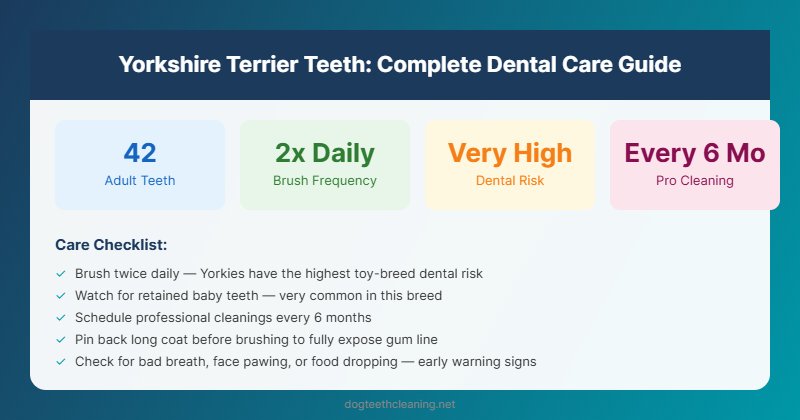
yorkshire terrier teeth is a lifelong commitment that every Yorkshire Terrier owner should prioritize. Yorkshire Terriers have the same 42 adult teeth as other dogs, yet their unique jaw structure, size, and temperament create specific dental challenges worth understanding. This complete guide covers everything you need to know about yorkshire terrier teeth care, brushing techniques, professional cleanings, and warning signs.
Yorkshire Terrier Teeth: Anatomy and Dental Profile
The Yorkshire Terrier is one of the most popular toy breeds in the world — and one of the most dentally challenged. Their very small jaw creates significant dental crowding, with all 42 permanent teeth packed into minimal longitudinal space. The result is familiar to anyone who has examined a Yorkie’s mouth: overlapping incisors, rotated premolars, and teeth erupting at angles that create deep bacterial pockets throughout. The long, silky floor-length coat traps food particles near the mouth when not properly managed. Retained deciduous teeth are extremely common in Yorkshire Terriers — one of the breeds where retained baby teeth should be considered the expectation rather than the exception without careful early monitoring and veterinary involvement.
According to the American Veterinary Medical Association (AVMA), dental disease is the most common health condition in adult dogs, affecting over 80% of dogs by age three. For Yorkshire Terriers, early and consistent yorkshire terrier teeth care is the most effective prevention strategy.
How to Brush Yorkshire Terrier Teeth
Brush your Yorkshire Terrier’s teeth twice daily without exception. Their extreme tooth crowding means bacterial pockets form faster and in more locations than in large breeds, making daily mechanical disruption of plaque critical. Part the long facial hair and pin it back before brushing, then use the smallest soft-bristled brush you can find — many Yorkie owners prefer finger brushes, which allow better tactile feedback when navigating crowded, rotated teeth. Use enzymatic dog toothpaste, which provides chemical antimicrobial activity in areas bristles cannot physically reach. Starting handling the puppy’s mouth during the first week home creates the behavioral foundation for lifelong acceptance of brushing.
- Choose the right tools: Use a dog-specific toothbrush or silicone finger brush with enzymatic toothpaste formulated for dogs.
- Start slow: Let your Yorkshire Terrier sniff and lick the toothpaste before introducing the brush.
- Focus on the gumline: Hold the brush at a 45-degree angle to the gum line where plaque accumulates.
- Brush in circles: Use small circular motions on all tooth surfaces — outer, inner, and chewing surfaces.
- Reward generously: Always follow brushing with praise or a dental treat to build positive associations.
Warning Signs of Dental Problems in Yorkshire Terriers
Periodontal disease is nearly universal in Yorkshire Terriers without aggressive preventive care. Studies on toy breeds consistently rank Yorkies among the highest-risk groups for early-onset dental disease. The consequences extend well beyond the mouth: dental bacteria entering the bloodstream are linked to mitral valve disease — which Yorkies are already predisposed to — as well as kidney disease and systemic inflammation. Never dismiss Yorkie halitosis as just bad breath — it is almost always a sign of active gingival or periodontal disease requiring professional attention. Watch for pawing at the mouth, reduced appetite, head tilting while eating, and reluctance to chew hard toys as signs that dental pain may already be present.
- Persistent bad breath (halitosis) beyond normal “dog breath”
- Visible yellow-brown tartar deposits on teeth, especially near the gum line
- Red, swollen, or bleeding gums
- Loose or missing teeth
- Difficulty chewing, dropping food, or avoiding hard kibble
- Pawing at the mouth or face
- Drooling more than usual
- Facial swelling, especially below the eye (possible tooth abscess)
Professional Dental Cleaning for Yorkshire Terriers
Yorkshire Terriers should receive professional dental cleanings every 6 months — not annually. Their extreme crowding and toy-breed metabolism make twice-yearly professional care the minimum standard, not an optional extra. Some individuals need cleanings as frequently as every 4–5 months based on tartar accumulation rate. Dental radiographs at every appointment are non-negotiable for this breed — subgingival bone loss progresses silently and is only detectable on X-ray. The most expensive mistake Yorkie owners make is delaying professional cleanings until teeth are visibly loose — by that point, extractions are almost always necessary and recovery is more complex and costly.
Professional cleanings involve a thorough examination, full-mouth dental X-rays, scaling above and below the gumline, polishing, and treatment of any diseased teeth. Your vet will also assess for periodontal disease, a common but serious condition if left untreated. Most dogs recover fully within 24 hours and immediately benefit from a clean, healthy mouth.
Diet and Dental Chews for Yorkshire Terrier Teeth
Feed your Yorkshire Terrier a high-quality, complete diet designed for toy breeds. Dry kibble of appropriate size provides mild chewing action. Dental-formulated diets such as Hill’s Prescription Diet t/d have the strongest clinical evidence for plaque and tartar reduction and are worth discussing with your vet for this very high-risk breed. VOHC-approved dental chews for small dogs supplement brushing effectively. Avoid a diet based entirely on wet or soft food, as these leave far more residue on tooth surfaces. Fresh water available at all times aids in rinsing oral bacteria between brushing sessions.
- VOHC-approved dental chews: Look for the Veterinary Oral Health Council (VOHC) seal on dental treats.
- Dry kibble: Crunchy kibble creates a mild abrasive effect that reduces plaque — better than soft food alone.
- Raw carrots or apple slices: Natural crunchy snacks that help clean teeth mechanically.
- Dental water additives: Antimicrobial additives in drinking water reduce bacteria in the mouth.
- Avoid: Sticky treats, cooked bones, and hard items that can crack teeth (e.g., antlers, ice).
Yorkshire Terrier-Specific Dental Notes
The Yorkshire Terrier consistently appears on lists of breeds with the worst dental disease outcomes — not because they are inherently unhealthy, but because the combination of extreme jaw crowding, toy size, and often inadequate dental care creates predictable and serious problems. Yorkie owners who commit to daily brushing and twice-yearly cleanings consistently report dramatically better long-term outcomes than those who skip home care. The breed’s long lifespan of 13 to 16 years means that dental disease left unaddressed will cause pain, systemic illness, and reduced quality of life for a significant portion of the dog’s life. Dental care for a Yorkie is not optional maintenance — it is a core pillar of responsible ownership for this beloved breed.
Learn more about the AKC’s Yorkshire Terrier breed profile to understand this breed’s full health needs. For a complete overview of dental care across all life stages, visit our breed dental health guide and our comprehensive dog dental care resource.
Frequently Asked Questions About Yorkshire Terrier Teeth
- Q: Why do Yorkshire Terriers have such bad teeth?
Yorkies have very small jaws but the same number of teeth (42) as much larger breeds. This creates severe crowding — teeth overlap, rotate, and trap food in pockets that are nearly impossible to clean thoroughly at home. This structural reality, combined with small body size and often heavy reliance on soft foods, makes rapid dental disease development almost inevitable without consistent preventive care. - Q: How often do Yorkies need professional teeth cleaning?
Every 6 months is the standard recommendation for Yorkshire Terriers, and some individuals need cleanings as frequently as every 4–5 months. Once-yearly cleanings are generally insufficient for this breed given the rate of tartar accumulation associated with their crowded dentition and toy breed metabolism. - Q: Can I avoid professional teeth cleaning if I brush my Yorkie’s teeth every day?
Daily brushing dramatically reduces the severity of disease found at each appointment, but does not eliminate the need for professional care. Brushing cannot remove tartar that has already hardened, and cannot clean below the gum line where periodontal disease originates. Professional cleanings remain essential even for well-brushed Yorkies — think of them as equivalent to adult dental check-ups for humans who brush twice daily. - Q: My Yorkie’s baby teeth did not fall out on their own — is this a problem?
Yes. Retained deciduous teeth are very common in Yorkshire Terriers and should be evaluated by a veterinarian if present after 6 months of age. Retained teeth create double rows that crowd permanent teeth into abnormal positions and dramatically accelerate periodontal disease. Most veterinarians recommend extracting retained teeth, ideally at the time of spay or neuter surgery.