Caring for your Alaskan Klee Kai‘s teeth is one of the most important things you can do for their long-term health. Dental disease affects over 80% of dogs by age three, and alaskan klee kai teeth care requires a breed-specific approach.
Alaskan Klee Kai Dental Anatomy & Risk Profile
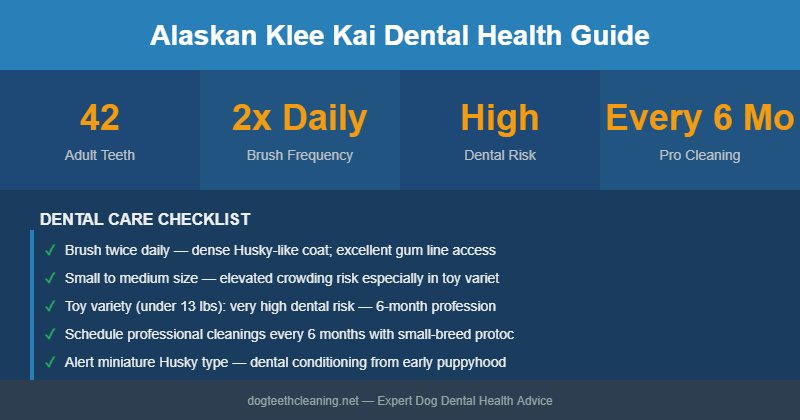
The Alaskan Klee Kai is a small-to-medium Husky-type breed from Alaska, available in toy (under 13 lbs), miniature (13–18 lbs), and standard (18–25 lbs) varieties. In the toy variety especially, the small jaw creates elevated dental crowding risk at rear premolars and molars. The dense double coat in black/white, grey/white, or red/white shades lies flat near the gum line. Dental disease risk is elevated in smaller varieties.
How to Brush Your Alaskan Klee Kai’s Teeth
Brush your Alaskan Klee Kai’s teeth twice daily using a small toothbrush or finger brush with enzymatic dog toothpaste. The dense coat provides good gum line access. Alaskan Klee Kais are alert, high-energy, and somewhat wary with strangers — dental care conditioning from early puppyhood is important in this vocal, independent miniature Husky type.
Warning Signs of Dental Disease in Alaskan Klee Kais
Elevated dental disease risk, particularly in the toy variety. Smaller jaw sizes increase crowding risk at rear premolars and molars. Signs include persistent bad breath, tartar buildup, gum redness or bleeding.
Professional Dental Cleanings for Alaskan Klee Kais
Every 6 months for toy and miniature varieties; annually for standards with excellent home care. Small-breed anesthetic protocols with precise weight-based dosing are required.
Diet and Dental Health for Alaskan Klee Kais
High-quality complete diet appropriate for its size variety. VOHC-approved dental chews sized for small to medium dogs. Water additives.
Breed Notes: Alaskan Klee Kai
Developed by Linda Spurlin in Wasilla, Alaska, as a companion-sized version of the Alaskan Husky. “Klee Kai” means “little dog” in an Athabascan language. UKC and AKC Foundation Stock Service recognition. Expected lifespan is 12 to 16 years.
For authoritative veterinary dental guidelines, see the AVMA pet dental care guide and the AKC Alaskan Klee Kai breed page.
Frequently Asked Questions: Alaskan Klee Kai Teeth
Is the Alaskan Klee Kai a miniature Husky?
The Alaskan Klee Kai resembles a miniature Siberian Husky but is a distinct breed developed from Alaskan Husky, Siberian Husky, American Eskimo Dog, and Schipperke crosses — not simply a downsized Siberian Husky.
How often should Alaskan Klee Kais have professional dental cleanings?
Every 6 months for toy and miniature varieties; annually for standard size with excellent home care. Small-breed anesthetic protocols required.
What does Klee Kai mean?
“Klee Kai” means “little dog” in an Athabascan language, referencing its origin as a companion-sized working dog developed in Wasilla, Alaska.
Is the Alaskan Klee Kai rare?
Relatively rare but growing in popularity. Less common than the Siberian Husky, maintained by dedicated breeders who prioritize health and temperament.