Caring for your American Alsatian‘s teeth is one of the most important things you can do for their long-term health. Dental disease affects over 80% of dogs by age three, and american alsatian teeth care requires a breed-specific approach.
American Alsatian Dental Anatomy & Risk Profile
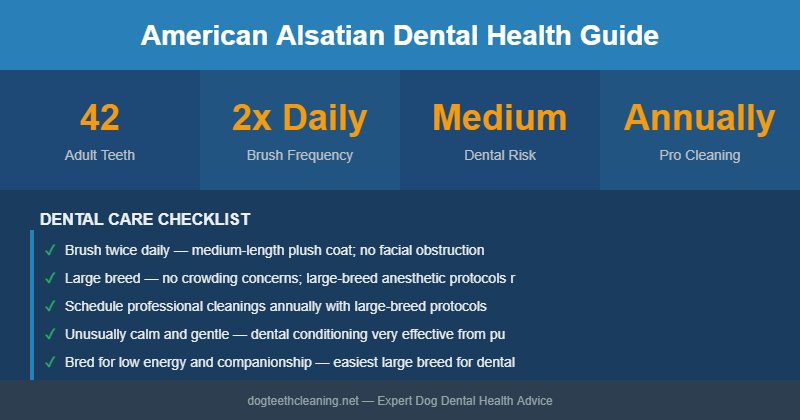
The American Alsatian is a large breed developed to resemble the prehistoric Dire Wolf with a calm companion temperament, weighing 79 to 120 pounds. Developed from Alaskan Malamute, German Shepherd, Great Pyrenees, English Mastiff, and Anatolian Shepherd crosses. As a large breed, the broad muzzle provides good jaw space for all 42 permanent teeth with no crowding concerns. Dental disease risk is moderate.
How to Brush Your American Alsatian’s Teeth
Brush your American Alsatian’s teeth twice daily using a large toothbrush or finger brush with enzymatic dog toothpaste. American Alsatians are intentionally bred for a calm, gentle, low-energy temperament — making dental care conditioning from early puppyhood unusually straightforward in this docile breed.
Warning Signs of Dental Disease in American Alsatians
Moderate dental disease risk consistent with large companion breeds. Signs include persistent bad breath, tartar buildup, gum redness or bleeding. Large-breed anesthetic protocols are required at professional cleanings.
Professional Dental Cleanings for American Alsatians
Schedule professional dental cleanings annually. Large-breed anesthetic protocols with weight-based dosing are required.
Diet and Dental Health for American Alsatians
Feed your American Alsatian a high-quality, complete diet for a large companion breed. Large dry kibble, VOHC-approved dental chews for large breeds, water additives.
Breed Notes: American Alsatian
Developed by Lois Schwarz beginning in the 1980s to recreate the appearance of the prehistoric Dire Wolf in a calm family companion. Registered with the National American Alsatian Registry. Not yet AKC recognized. Expected lifespan is 9 to 13 years.
For authoritative veterinary dental guidelines, see the AVMA pet dental care guide and the AKC American Alsatian breed page.
Frequently Asked Questions: American Alsatian Teeth
Was the American Alsatian bred to look like a Dire Wolf?
Yes — specifically developed to recreate the appearance of the Dire Wolf (Aenocyon dirus), extinct approximately 9,500 years ago, while maintaining an extremely calm companion temperament.
How often should American Alsatians have professional dental cleanings?
Annual cleanings for dogs with excellent home care. Large-breed anesthetic protocols are required.
Is the American Alsatian aggressive?
No — it is intentionally bred to be one of the calmest, gentlest large breeds. Fearfulness, aggression, and high energy are actively bred against.
Is the American Alsatian rare?
Yes — uncommon internationally, found primarily in the United States and maintained by a small network of dedicated breeders.