German Shorthaired Pointer teeth are an important part of overall health for this versatile, high-energy sporting breed. Known for their athleticism, intelligence, and friendly temperament, German Shorthaired Pointers (GSPs) are one of the most popular hunting and sport dog breeds in the world. But regardless of their active lifestyle, German Shorthaired Pointer teeth require consistent preventive care to avoid periodontal disease, tartar accumulation, and the systemic health consequences that accompany untreated dental infection.
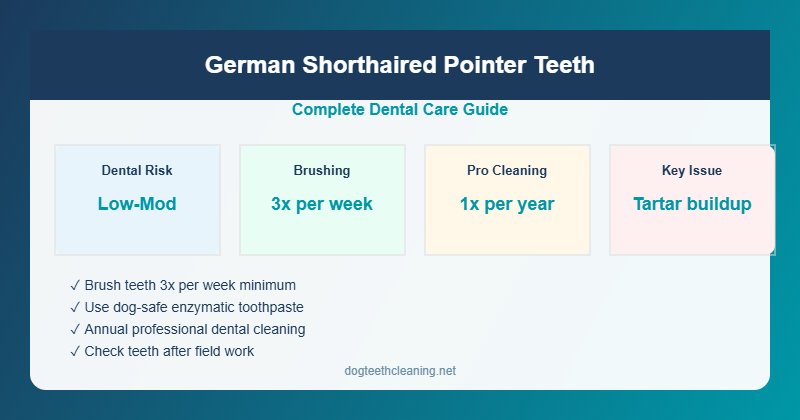
German Shorthaired Pointer Teeth: Anatomy and Dental Profile
Adult German Shorthaired Pointers have 42 permanent teeth — the standard count for all adult dogs. These consist of 12 incisors, 4 canines, 16 premolars, and 10 molars. The German Shorthaired Pointer teeth are proportional to the breed’s medium-to-large frame and moderately strong jaw, designed for field work including retrieving game from water and land. GSPs have a scissors bite (the upper incisors closely overlapping the lower), which is the breed standard and optimal for both function and dental health.
Puppies begin with 28 deciduous teeth, which start falling out around 3 to 4 months of age. Adult German Shorthaired Pointer teeth are typically fully erupted by 6 to 7 months. Because GSPs are energetic puppies with strong chewing instincts, this period requires careful management of chewing objects to prevent damage to emerging permanent teeth.
The German Shorthaired Pointer has a relatively low-to-moderate dental disease risk compared to short-faced or toy breeds. However, the American Veterinary Medical Association (AVMA) notes that over 80% of dogs show dental disease signs by age 3 regardless of breed, making consistent preventive care essential for every GSP.
How to Brush German Shorthaired Pointer Teeth: Complete Guide
Brushing is the most effective preventive tool for maintaining healthy German Shorthaired Pointer teeth. GSPs are energetic and intelligent dogs that typically respond well to training-based approaches — making the establishment of a brushing routine more straightforward than with many other breeds, provided it begins early and uses consistent positive reinforcement.
Here is a step-by-step guide to brushing German Shorthaired Pointer teeth:
- Start in puppyhood: Begin oral handling as early as 8 weeks. Touch the muzzle, lips, and gums regularly during play and calm periods. The earlier this becomes routine, the more cooperative your GSP will be throughout its life.
- Choose the right equipment: Use a soft-bristled dog toothbrush or a finger brush, paired with enzymatic dog toothpaste in a flavor your GSP finds appealing — poultry, beef, or vanilla mint are popular choices. Never use human toothpaste; xylitol and fluoride are toxic to dogs.
- Use correct technique: Angle the brush at 45 degrees to the gum line. Use small circular or back-and-forth motions, focusing on the outer surfaces of all teeth. The upper premolars and molars are highest-risk sites for tartar on German Shorthaired Pointer teeth.
- Be systematic: Work from front to back on both sides of the upper and lower jaw. A consistent sequence ensures no area of German Shorthaired Pointer teeth is missed in each session.
- Keep it positive: End each session with verbal praise, brief play, or a VOHC-approved dental treat. Short, positive sessions three or more times per week are far more effective than occasional longer brushing attempts.
GSPs used for hunting should have their teeth checked after each field session. Sticks, burrs, and hard debris can lodge between teeth or damage the gum line during field work. A quick visual inspection after hunting helps catch problems early before they progress.
Warning Signs in German Shorthaired Pointer Teeth
Catching dental disease early protects your GSP from pain and prevents more serious systemic complications. Watch for these warning signs in German Shorthaired Pointer teeth:
- Persistent bad breath: A foul or ammonia-like odor beyond normal dog breath indicates active bacterial activity in the mouth.
- Visible tartar buildup: Yellow-brown calcified deposits on the tooth surfaces, especially near the gum line of German Shorthaired Pointer teeth, need professional scaling.
- Red or bleeding gums: Inflamed, bleeding gums are the hallmark of gingivitis — the earliest and most reversible stage of periodontal disease.
- Tooth fractures: Slab fractures — where a large piece of enamel and dentin breaks off — are common in sporting dogs that retrieve sticks or hard objects. Fractured German Shorthaired Pointer teeth expose the pulp and create infection pathways.
- Changes in eating behavior: Reluctance to chew kibble, dropping food, or favoring one side of the mouth indicate dental pain.
- Loose teeth: Advanced periodontal bone loss causes tooth mobility and eventually tooth loss in German Shorthaired Pointer teeth.
Professional Dental Cleaning for German Shorthaired Pointers
Annual professional dental cleanings are an essential component of complete care for German Shorthaired Pointer teeth. No home care routine — regardless of frequency or thoroughness — can remove subgingival tartar or evaluate root and bone health the way anesthesia-assisted professional cleaning can.
During a professional dental cleaning, the veterinary team uses ultrasonic and hand scalers to remove all supra- and subgingival tartar from German Shorthaired Pointer teeth, probes each tooth’s sulcus for pocketing indicative of periodontitis, takes full-mouth dental radiographs, and polishes enamel surfaces to slow future plaque adhesion. Any fractured or abscessed teeth detected during the procedure may be extracted or referred for root canal therapy.
Most healthy adult GSPs tolerate anesthesia very well. Pre-anesthetic bloodwork ensures organ function is adequate before proceeding. The risk of anesthesia in a healthy, well-screened dog is far lower than the cumulative risk of untreated dental disease over a lifetime.
Diet, Chews, and Field Care for German Shorthaired Pointer Teeth
Dry kibble and dental diets: Standard dry kibble provides mild mechanical abrasion on German Shorthaired Pointer teeth. Veterinary dental diets (VOHC-certified) provide more effective plaque reduction through specially engineered kibble texture designed to clean teeth during each bite.
VOHC-approved dental chews: Choose large-dog VOHC-certified chews appropriate for a medium-to-large breed. These provide evidence-based plaque and tartar reduction between brushing sessions.
Field-specific caution: Hunting GSPs are frequently exposed to sticks, branches, and hard debris during retrieves. Sticks in particular are a leading cause of oral injuries and tooth fractures in sporting dogs. Training your GSP to retrieve soft bumpers rather than sticks protects German Shorthaired Pointer teeth from avoidable field injuries.
German Shorthaired Pointer Breed Dental Notes
The German Shorthaired Pointer is a versatile hunting breed developed in Germany in the 19th century for pointing, tracking, and retrieving on both land and water. According to the American Kennel Club (AKC), the GSP consistently ranks among the top 10 most popular dog breeds in the United States, prized for its athleticism, trainability, and affectionate nature. The breed typically lives 10 to 12 years — a lifespan during which consistent dental care has a compounding positive effect on health and quality of life.
Oral bacteria from untreated periodontal disease affecting German Shorthaired Pointer teeth can enter the bloodstream and damage the heart valves, kidneys, and liver. For an active working dog like the GSP, maintaining dental health directly supports cardiovascular function and endurance — core components of the breed’s working ability.
For more breed-specific dental information, visit our breed dental health guides and comprehensive dog dental care resource hub.
Frequently Asked Questions About German Shorthaired Pointer Teeth
How often should I brush German Shorthaired Pointer teeth?
Daily brushing is ideal for German Shorthaired Pointer teeth. At minimum, three times per week significantly reduces plaque and tartar accumulation. GSPs are trainable and typically accept brushing readily once conditioned to the routine.
Do hunting dogs like German Shorthaired Pointers get tooth fractures?
Yes. Retrieving sticks, hard bumpers, or game with hard bones can fracture German Shorthaired Pointer teeth. Training your GSP to retrieve soft objects and inspecting its teeth after field sessions helps catch fractures early.
How do I know if my German Shorthaired Pointer has dental disease?
Key signs include bad breath, visible tartar on German Shorthaired Pointer teeth, red or bleeding gums, reluctance to eat hard food, and changes in chewing behavior. Annual veterinary dental exams provide the most reliable detection.
Related reading: Dogo Argentino dental care guide