Caring for your Black Russian Terrier‘s teeth is one of the most important things you can do for their long-term health. Dental disease affects over 80% of dogs by age three, and black russian terrier teeth care requires a breed-specific approach.
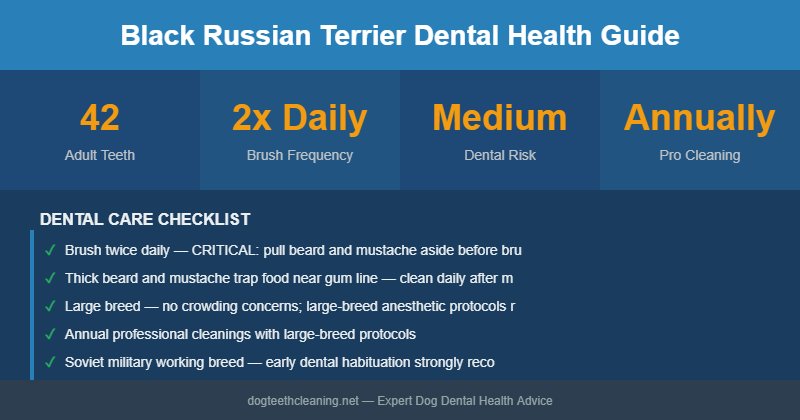
Black Russian Terrier Dental Anatomy & Risk Profile
The Black Russian Terrier is a large, powerful Russian working breed developed by Soviet military kennel programs from multiple working breeds including Giant Schnauzer, Airedale Terrier, Rottweiler, and others, weighing 80 to 130 pounds. The breed’s most important dental consideration is its distinctive thick, tousled black beard and mustache — this heavy facial coat traps food debris directly against the gum line, significantly elevating local bacterial accumulation. The beard must be pulled aside completely before brushing. Large-breed anesthetic protocols are required. Dental disease risk is moderate to elevated due to the facial coat.
How to Brush Your Black Russian Terrier’s Teeth
Brush your Black Russian Terrier’s teeth twice daily using a large toothbrush or finger brush with enzymatic dog toothpaste. CRITICAL: pull the thick beard and mustache completely aside before brushing — food trapped in facial coat is a significant source of dental bacteria in this breed. Clean the beard after meals. Work at a 45-degree angle. Black Russian Terriers are confident, trainable, and deeply loyal — dental conditioning from early puppyhood is strongly recommended before the breed’s naturally assertive personality matures.
Warning Signs of Dental Disease in Black Russian Terriers
Moderate to elevated dental disease risk due to food-trapping beard and mustache. Food and debris trapped in facial coat create localized bacterial buildup at gum line. Signs include bad breath, lip fold inflammation, tartar buildup, gum redness. Large-breed anesthetic protocols required.
Professional Dental Cleanings for Black Russian Terriers
Annual professional dental cleanings. Large-breed anesthetic protocols with weight-based dosing required.
Diet and Dental Health for Black Russian Terriers
High-quality complete diet for a large working breed. Large dry kibble, VOHC-approved dental chews for large breeds, water additives.
Breed Notes: Black Russian Terrier
The Black Russian Terrier (Черный терьер, Chorny Terrier) was developed by Soviet military breeding programs at the Red Star Kennel beginning in the late 1940s, combining over 17 breeds to create a robust, versatile working dog. AKC recognition 2004 in the Working Group. Lifespan 10–11 years.
For authoritative veterinary dental guidelines, see the AVMA pet dental care guide and the AKC Black Russian Terrier breed page.
Frequently Asked Questions: Black Russian Terrier Teeth
Why does the Black Russian Terrier’s beard create dental concerns?
The Black Russian Terrier’s thick beard and mustache trap food debris directly against the gum line after every meal, creating a reservoir of bacteria against the teeth and gums. Without daily cleaning of the beard and twice-daily brushing, periodontal disease develops significantly faster than in smooth-faced breeds.
How often should Black Russian Terriers have professional dental cleanings?
Annual cleanings for dogs with excellent home care. Large-breed anesthetic protocols with weight-based dosing are required for a dog that may exceed 100 pounds.
What breeds make up the Black Russian Terrier?
The Black Russian Terrier was developed from over 17 breeds, primarily Giant Schnauzer, Airedale Terrier, and Rottweiler, with contributions from Newfoundland, Great Dane, Caucasian Shepherd Dog, and others.
Is the Black Russian Terrier actually a terrier?
Despite the name, the Black Russian Terrier has very little terrier heritage and temperament. It is classified as a working breed and functions as a guardian and military/police dog rather than a traditional earth dog terrier.